Overview
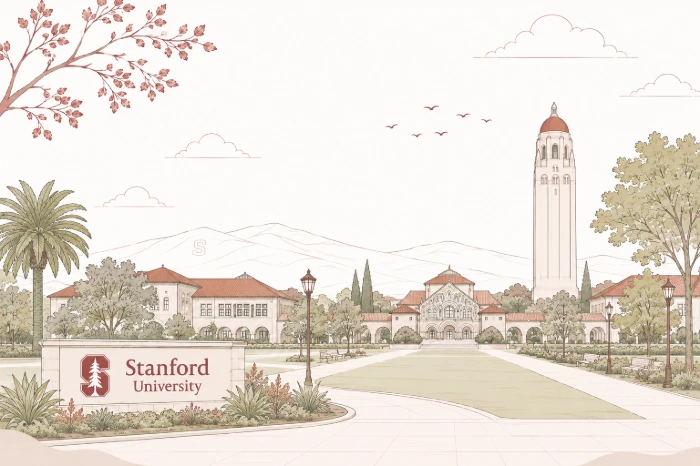
Situated in Stanford, California, right in the heart of Silicon Valley, Stanford University stands as
the undisputed engine of global tech innovation and entrepreneurship. Established in 1885 by
Leland and Jane Stanford, its massive 8,180-acre campus—affectionately known as "The
Farm"—harmoniously blends iconic Spanish colonial architecture with hyper-modern research
laboratories and sprawling open spaces. Operating under the unofficial ethos of relentless
innovation, Stanford acts as the central nervous system of the world's tech industry, having
birthed companies like Google, HP, and Snapchat. Today, the university boasts a dynamic
academic population of around 17,000 students (roughly 7,000 undergraduates and 10,000
postgraduates), including a highly diverse international cohort representing over 14% of the
undergraduate class and a large percentage of graduate programs, hailing from over 70
countries.
#2
QS 2027 Rank
#5
TUC 2027 Rank
#3
North America (TUC)
Stats
● Career and Post-Grad Placement: Stanford reports an extraordinary overall placement rate, with undergraduates aggressively recruited by Silicon Valley tech giants (Apple, Meta, Google), top-tier venture capital firms, and management consultancies. A staggering number of alumni ultimately launch their own startups directly out of dorm rooms, fueled by unparalleled access to Sand Hill Road's venture capital ecosystem.
● Professor Quality: With an incredibly favorable student-to-faculty ratio of 5:1, students are instructed by active creators of modern scientific and economic paradigms, including numerous Nobel Laureates, Turing Award winners, and MacArthur "Genius" Fellows.
● Study Environment: Often famously described by the "Stanford Duck Syndrome"—gliding effortlessly on the surface while paddling furiously underneath—Stanford cultivates an intensely rigorous academic atmosphere balanced by a famously laid-back, sun-drenched California lifestyle. Student reviews praise the campus's world-class athletic facilities, collaborative maker spaces (like the d.school), and over 600 active student clubs.
Courses
65+
Primary UG
200+
Doctoral (PHD)
100+
Masters (PG)
All
Masters (English)
The most popular and highest-ranked programs include Computer Science, Engineering,
Economics, Human Biology, and Business Administration (GSB). Recently, Stanford has
continued its profound pedagogical emphasis on interdisciplinary studies. Initiatives like the
Stanford Doerr School of Sustainability and the Hasso Plattner Institute of Design (the
"d.school") are designed to break down traditional disciplinary boundaries, ensuring students
integrate design thinking, AI, and environmental sciences before specializing in their designated
majors.
Navigating Admissions: The International Student Pathway
The gateway to Stanford for international students is brutally competitive. While Stanford evaluates domestic and international students through the same holistic lens, the acceptance rate for recent classes sits around a historically low 3.6% to 3.8%, making it one of the most selective universities in the world.
The step-by-step admission process requires:
1. Eligibility: Applicants must be applying for their first undergraduate degree. International candidates go through the same comprehensive review as domestic applicants.
2. Academic Excellence: Undergraduates need absolute elite credentials. Most admitted students are in the top 5% to 10% of their high school class. For students coming from systems like the Indian CBSE/ISC, this translates to consistently scoring 90-95%+ across all semesters.
3. Language Competence: While English proficiency tests (like TOEFL or IELTS) are not strictly mandatory for undergraduate applicants, they are strongly recommended for non-native speakers to prove fluency. For graduate programs, a TOEFL score of 90-100+ or IELTS of 7.0+ is typically required.
4. Standardized Examinations: Stanford holds highly competitive standardized testing averages. Submitted scores for admitted students typically sit between 1500 and 1570 on the SAT, or 34 and 35 on the ACT. Graduate applicants (like those aiming for the Stanford GSB) often submit GMAT scores of 720+ or GRE scores of 320+.
5. Documentation & Interviews: Applications require the Common Application, highly specific and deeply reflective Stanford supplemental essays (famously including the "Roommate Essay"), academic transcripts, and recommendation letters. Shortlisted candidates may be invited for an optional alumni interview in their home region.
For more Information and personalised answers please join our Discord server https://discord.gg/MtdNBUwF2b (all documents needed and other important things required for your application is posted on the server)
Financial Architecture:
Budget Split (In USD)
(This is an average data, the actual budget may vary from person to person)
Fees and Annual Budget:
The sticker price for a Stanford education is immense, but its financial aid program provides a massive ROI for those who qualify. For the 2026-2027 academic year, the standard undergraduate tuition is set at $67,731. Specialized postgraduate degrees carry higher costs; for example, tuition at Stanford Law School sits around $79,779, and the MBA program is similarly premium.
Beyond tuition, an international student living on campus should prepare for an estimated total cost of attendance of roughly $97,545.
This covers:
● On-Campus Housing and Food: $22,944/year.
● Student Fees & Books/Supplies: ~$3,465/year.
● Personal Expenses Allowance: $3,405/year.
● Medical Insurance & Travel: Variable (often adding $3,000 to $6,000+ depending on the home country).
(for more information please visit Stanford University)
Funding the Future:
Scholarship Opportunities:
Stanford offers a highly generous financial aid program, but international applicants must navigate a critical difference compared to some of its East Coast peers: Stanford is need-aware for international students.
● Need-Aware Admissions: This means your request for financial aid will be factored into your admission decision. Because the university has a limited financial aid budget for non-citizens, competition among international students requiring aid is exceptionally fierce.
● Meeting 100% of Demonstrated Need: If you are admitted as an international student and you requested aid, Stanford guarantees to meet 100% of your demonstrated financial need. Families with total incomes below specific thresholds (often around $100,000 USD) are generally not expected to pay tuition.
● No Merit Scholarships: Stanford does not offer any merit, athletic, or talent-based scholarships. All undergraduate funding is based strictly on financial need.
● Graduate Funding: For graduate students (particularly PhDs), funding is highly robust. Most doctoral students receive full tuition coverage and living stipends via research assistantships (RA) or teaching assistantships (TA)
For more scholarship updates and options please find it on our discord server https://discord.gg/MtdNBUwF2b
Why Choose Stanford University?
The Ultimate Pipeline to Silicon Valley and Global Tech: If you are looking past standard
brochure data, the ultimate reason to attend Stanford is its absolute fusion with the global tech
economy. Attending Stanford removes nearly all systemic barriers to entry in fields like artificial
intelligence, venture capital, and deep-tech entrepreneurship. The university operates less like a
traditional ivory tower and more like a massive incubator. By stepping onto "The Farm," you
place yourself at the very epicenter of technological disruption, where your professors are active
industry founders and your classmates are the next generation of unicorn CEOs. You don't just
study the future at Stanford; you build it in real-time.