Overview
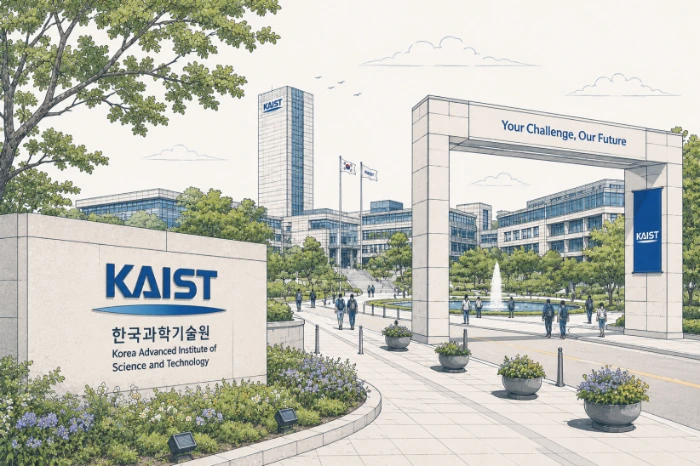
Situated in the high-tech hub of Daejeon (often referred to as South Korea's Silicon Valley), the
Korea Advanced Institute of Science and Technology (KAIST) is the nation's premier national
research university dedicated to science and engineering. Established in 1971 with funding from
the United States Agency for International Development (USAID), KAIST was built specifically to
industrialize South Korea and drive its rapid transition into a global technological superpower.
Today, it hosts a brilliant, highly focused population of over 10,000 students. Unlike traditional
comprehensive universities, KAIST operates almost exclusively within STEM fields, drawing a
fiercely competitive international and domestic cohort eager to access its elite laboratories,
state-of-the-art robotics, and unparalleled connections to the Korean tech industry.
#65
QS 2027 Rank
#35
TUC 2027 Rank
#11
Asia Rank (TUC)
Stats
●Career and Post-Grad Placement: KAIST provides a direct, highly lucrative pipeline into the highest echelons of South Korea's tech ecosystem, including heavy recruitment by massive conglomerates like Samsung, LG, Hyundai, and SK Hynix. Its exceptional ROI score (94.1%) reflects its status as the absolute gold standard for engineering and software talent in the nation.
● Professor Quality: Students are instructed by the absolute best scientists, engineers, and tech pioneers in South Korea. The university's Research Output is phenomenally strong (91.4%), heavily fueled by massive government grants and its location deep within the Daedeok Innopolis research cluster.
● Study Environment: KAIST cultivates an intensely rigorous, heavily quantitative "stress-cooker" atmosphere. Because it is physically removed from the relentless distractions of central Seoul, the campus is deeply focused and heavily residential. The university is famous for its hyper-modern facilities, autonomous delivery robots roaming the campus, and a profoundly collaborative (yet grueling) academic culture.
Courses
20+
Primary UG
100+
Doctoral (PHD)
50+
Masters (PG)
All
Masters (English)
The most popular and fiercely competitive undergraduate programs include Computer Science, Electrical Engineering, Aerospace Engineering, Mechanical Engineering, and Bio & Brain Engineering. One of KAIST's greatest advantages for international students is that the vast majority of its core curriculum—at both the undergraduate and graduate levels—is taught entirely in English.
Navigating Admissions: The International Student Pathway
The gateway for international students to enter KAIST is highly competitive, operating with distinct application cycles heavily reliant on flawless quantitative foundations.
The step-by-step admission process requires:
1. Eligibility & Track Selection: International applicants apply via the KAIST online admissions portal. You must meet specific eligibility criteria (typically requiring neither the applicant nor their parents to hold Korean citizenship). Unlike many global universities, you do not apply for a specific major right away; KAIST operates a highly flexible "no-major" track for freshmen, allowing you to declare your major after your first year.
2. Academic Excellence: Admissions are fiercely transcript-driven, demanding absolute perfection in mathematics and sciences. Incoming international students typically present elite scores in globally recognized systems (e.g., straight A*s at A-Level, a 40+ IB Diploma, or top AP scores in Calculus and Physics).
3. Standardized Examinations: KAIST strongly recommends submitting official standardized test scores. High SAT, ACT, or AP exam scores (particularly in STEM subjects) massively bolster an application and are often the deciding factor in securing admission against a highly competitive global pool.
4. Language Competence: English fluency is strictly required because most STEM courses are taught in English. A strong TOEFL iBT or IELTS Academic score is mandatory. (Korean proficiency is not required for admission, but students are required to take Korean language classes after enrolling).
5. The Application Package: Your application heavily relies on your Personal Statement and Letters of Recommendation. KAIST actively looks for highly resilient, globally minded students with a documented history of scientific curiosity (e.g., Olympiad medals, robotics competitions, or published high school research).
For more Information and personalised answers please join our Discord server https://discord.gg/MtdNBUwF2b (all documents needed and other important things required for your application is posted on the server)
Financial Architecture:
Budget Split (In KRW)
(This is an average data, the actual budget may vary from person to person)
Fees and Annual Budget:
Fees and Annual Budget: Because KAIST is a heavily subsidized national university, its
financial structure is absolutely unmatched, especially compared to elite US or UK tech
institutes. Standard international tuition typically sits around 7,000,000 to 9,000,000 KRW per year.
However, almost no international student pays this full amount (see Scholarship section
below).
Beyond tuition, Daejeon is significantly cheaper than central Seoul. A realistic estimated annual
living budget ranges from roughly 8,000,000 to 12,000,000 KRW.
*For more information visit https://www.korea.edu/sites/en/index.do
This covers:
● Accommodation: ~1,500,000 to 2,500,000 KRW/year (KAIST provides heavily subsidized, high-quality dormitory housing on campus for virtually all its students, making rent incredibly cheap).
● Food / Board: ~5,000,000 to 7,000,000 KRW/year (Eating at the subsidized campus cafeterias keeps daily costs extremely low).
● Student Fees & Transport: ~1,000,000 KRW/year.
● National Health Insurance: Mandatory and highly subsidized for all international
students.
Funding the Future:
Scholarship Opportunities: The single greatest financial advantage of attending KAIST is its incredibly generous, university-wide funding structure.
● KAIST International Student Scholarship: This is one of the most robust undergraduate funding packages in the world. Virtually all admitted international undergraduate students automatically receive this scholarship. It provides a full tuition waiver for all eight semesters and a monthly living allowance (approx. 350,000 KRW/month), completely removing the financial barrier to an elite STEM education. Students only need to maintain a baseline GPA (usually 2.7 out of 4.3) to keep the funding.
● Global Korea Scholarship (GKS): Funded by the South Korean government, this prestigious national award covers full tuition, a higher monthly living allowance, round-trip flights, and a year of intensive Korean language training.
● Graduate Funding: At the Master's and Ph.D. levels, virtually all students receive full
funding through research assistantships, covering all tuition costs and providing a
generous monthly living stipend.
For more scholarship updates and options please find it on our discord server https://discord.gg/MtdNBUwF2b
Why Choose KAIST?
The Ultimate STEM Engine of Asia: If you are looking past standard brochure data, the
ultimate reason to attend KAIST is the sheer, uncompromising return on investment. By
stepping onto the Daejeon campus, you are bypassing the massive six-figure debt of American
engineering schools to receive an identical, Ivy-tier technical education—usually for absolutely
free. KAIST does not just teach computer science or aerospace; it is deeply embedded in South
Korea's hyper-advanced R&D infrastructure. With a uniquely flexible first-year curriculum and a
campus culture heavily geared toward relentless innovation, graduating from KAIST gives you
an elite, globally respected degree that serves as a bulletproof launchpad into Silicon Valley or
the Asian tech giants.