Overview
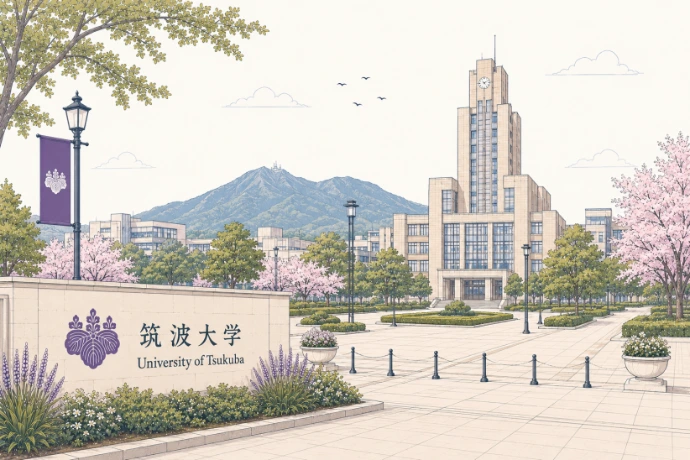
Situated just 45 minutes northeast of Tokyo in the heart of Tsukuba Science City, Tsukuba University stands as one of Japan's most expansive and innovative higher education institutions. Established in its current form in 1973 (tracing its roots back to normal schools founded in 1872), its massive 258-hectare campus is the second-largest single campus in Japan. Operating under a philosophy of "flexible education and research," the university acts as the academic core of a city that hosts over 200 national and private research institutes. Today, the university boasts a dynamic academic population of over 16,500+ students, including a highly diverse international cohort of over 2,200+ students representing more than 110 countries.
#350
QS 2027 Rank
#279
TUC 2027 Rank
#74
Asia Rank (TUC)
Stats
- Career and Post-Grad Placement: Tsukuba University offers a robust pipeline into Japan's cutting-edge research, technology, and engineering sectors. Graduates are heavily recruited by domestic tech conglomerates, international corporations operating in Tokyo, and national research institutes. The university features an exceptionally high retention rate of post-graduates entering advanced academic research.
- ● Professor Quality: Integrated deeply into Tsukuba Science City, students are instructed by elite researchers and scientists. The university's academic lineage boasts multiple Nobel Laureates, particularly in physics and chemistry, ensuring students have access to top-tier mentorship.
- ● Study Environment: Tsukuba cultivates a serene but intensely innovative atmosphere.
Unlike the concrete jungles of central Tokyo universities, Tsukuba is renowned for its lush,
green campus, extensive bicycle paths, and massive sporting facilities. It is famously
recognized for its elite Sports Science programs, having nurtured numerous Olympians.
Courses
80+
Primary UG
80+
Doctoral (PHD)
130+
Masters (PG)
40+
Masters (English)
- The most popular and highest-ranked programs include Sports Science, Life and Environmental Sciences, Physics, Computer Science, and International Relations. Tsukuba University operates on a highly flexible, interdisciplinary cluster system rather than traditional rigid faculties. This allows students to cross-register for classes across different disciplines seamlessly.
Navigating Admissions: The International Student Pathway
The gateway for international students to enter Tsukuba University is well-structured, offering dedicated pathways for both Japanese-taught and English-taught programs.
The step-by-step admission process requires:
1. Eligibility: Applicants must be non-Japanese citizens who have completed or are expected to complete 12 years of formal education abroad.
2. Academic Excellence: Undergraduates need strong high school credentials. For English-taught undergraduate programs (like the Interdisciplinary Program in Life and Environmental Sciences or International Social Studies), competitive grades in relevant high school subjects are essential.
3. Language Competence: English-taught programs strictly mandate proof of English proficiency, typically an IELTS score of 6.0+ or a TOEFL iBT score of 80+. For Japanese-taught programs, students must generally demonstrate an N1 or N2 level on the JLPT.
4. EJU Examination: For many standard Japanese-taught undergraduate programs, international students must take the Examination for Japanese University Admission for International Students (EJU), covering subjects like Japanese as a Foreign Language, Science, Japan and the World, and Mathematics.
5. Documentation & Interviews: Applications require an online application, authenticated high school transcripts, a personal statement, language certificates, and recommendation letters. Shortlisted candidates are usually invited for an online or in-person interview.
For more Information and personalised answers please join our Discord server https://discord.gg/MtdNBUwF2b (all documents needed and other important things required for your application is posted on the server)
Financial Architecture:
Budget Split (IN YEN)
(This is an average data, the actual budget may vary from person to person)
- Fees and Annual Budget: Tsukuba University offers an incredible financial ROI, particularly because it maintains standard national university tuition rates while being located in a city with a much lower cost of living than Tokyo. Annual tuition is strictly set at ¥535,800 for standard undergraduate and master's programs. Beyond tuition, an international student living in Tsukuba should prepare an estimated annual budget of roughly ¥960,000 to ¥1,400,000.
This covers:
● On-Campus Accommodation (Dormitories): Tsukuba has an extensive dormitory system, costing roughly ¥15,000 to ¥38,000 per month (approx. ¥180,000 to ¥456,000/year).
● National Health Insurance: ~¥20,000/year.
● Living Expenses (Food, Utilities, Transport): ~¥50,000 to ¥75,000/month (riding a
bicycle is the primary mode of transport, saving massively on commuting costs).
Funding the Future:
Scholarship Opportunities: The Japanese government and Tsukuba University provide excellent financial pipelines to attract top global minds.
● MEXT Scholarship (Japanese Government): The most prestigious national award. A fully funded MEXT scholarship covers the entire admission and tuition fees and provides a monthly living stipend (approx. ¥117,000 for undergraduates).
● Tsukuba Scholarship: A university-specific support program for international students, which can offer a monthly stipend or partial tuition waivers for students demonstrating high academic achievement and financial need.
● JASSO Honors Scholarship: A privately funded scholarship providing a monthly stipend (usually ¥48,000/month) for a duration of 6 to 12 months for outstanding privately financed international students.
For more scholarship updates and options please find it on our discord server https://discord.gg/MtdNBUwF2b
Why Choose Tsukuba University?
The Academic Core of Japan's Science City: If you are looking past standard brochure data,
the ultimate reason to attend Tsukuba University is its unparalleled integration with Japan's
premier research hub. By stepping onto this massive, deeply green campus, you bypass the
cramped, high-cost environment of central Tokyo while maintaining direct access to
world-leading facilities in robotics, environmental sciences, and physics. You are not just earning
a degree; you are integrating into a purpose-built scientific ecosystem where collaboration
between university labs, corporate R&D centers, and national space agencies happens daily