Overview
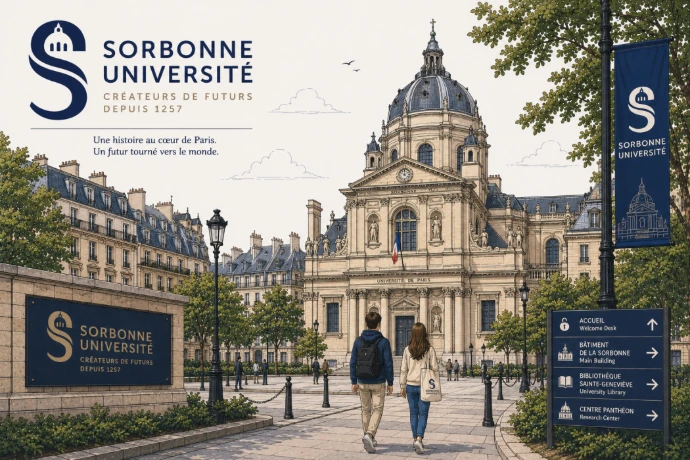
Situated in the historic, intellectual heart of Paris, Sorbonne University (Sorbonne Université) is a globally recognized public research powerhouse and one of the most prestigious institutions in Europe. While the modern university was officially formed in 2018 through the merger of Paris-Sorbonne University and Pierre and Marie Curie University, its legendary academic lineage traces back to the 13th century. Sorbonne University operates across multiple iconic campuses in Paris—most notably the historic Latin Quarter and the sprawling Pierre and Marie Curie campus in Jussieu. Today, it hosts a massive, deeply driven population of over 55,000 students, drawing a fiercely ambitious international cohort eager to tap into its world-renowned humanities, medicine, and rigorous natural science tracks, all while living in one of the most culturally vibrant capitals on earth.
#73
QS 2027 Rank
#69
TUC 2027 Rank
#18
Europe Rank (TUC)
Stats
● Career and Post-Grad Placement: Sorbonne University provides a highly respected pipeline into Europe’s leading scientific research centers, the French civil service, and massive international corporations based in Paris. Its solid Employer Reputation (83.5%) and formidable ROI (87.4%) reflect its status as a foundational pillar of French professional and academic development.
● Professor Quality: Students are instructed by some of Europe's top academic minds, including Fields Medalists and leading global researchers. The university boasts an exceptional Research Output of 86.0%, heavily fueled by its world-class laboratories in mathematics, computer science, and marine biology, as well as its massive university hospital network.
● Study Environment: Sorbonne cultivates a prestigious, fiercely independent, and
intellectually rigorous atmosphere. The French university system expects massive
self-reliance; there is very little hand-holding. While Paris is notoriously expensive and the
student housing market is brutal, the city offsets this by offering unparalleled access to
European art, historic architecture, and an incredibly rich café culture that serves as a
natural extension of the classroom.
Courses
150+
Primary UG
100+
Doctoral (PHD)
200+
Masters (PG)
SELECTIVE
Masters (English)
The most popular and brutally competitive programs include Mathematics, Computer Science, Medicine, History, Literature, Philosophy, and Natural Sciences. Crucial Note for Internationals: The vast majority of undergraduate (Bachelor's or Licence) programs at Sorbonne University are taught entirely in French. However, the university offers a rapidly expanding portfolio of elite, English-taught Master's and Ph.D. programs, particularly in the STEM fields.
Navigating Admissions: The International Student Pathway
The gateway to Sorbonne University operates strictly on objective academic merit rather than holistic essays, following the centralized French higher education framework.
The step-by-step admission process requires:
1. Eligibility & Track Selection: International students must possess a high school diploma equivalent to the French Baccalauréat.
2. The Études en France / Campus France Platform: For most non-EU international applicants, the application process goes exclusively through the official Études en France (Campus France) portal via the DAP (Demande d'Admission Préalable) procedure, typically open between October and December of the preceding year. EU citizens and some specific nationals apply through the Parcoursup portal.
3. Academic Excellence: Admissions are relentlessly transcript-driven. Highly competitive subjects (like Medicine or advanced Physics) demand top-tier grades in corresponding high school sciences and mathematics.
4. Language Competence:
○ French-Taught Programs: Near-native fluency is strictly required. Non-native speakers must submit a recognized certificate like the DELF B2, or more commonly for Sorbonne, the DALF C1 or TCF (Test de Connaissance du Français) with a high score.
○ English-Taught Programs: For English Master's tracks, a minimum IELTS Academic score of 6.5 or a TOEFL iBT equivalent is mandatory.
For more Information and personalised answers please join our Discord server https://discord.gg/MtdNBUwF2b (all documents needed and other important things required for your application is posted on the server)
Financial Architecture:
Budget Split (In EUR)
(This is an average data, the actual budget may vary from person to person)
Fees and Annual Budget:
The French government heavily subsidizes higher education, making it incredibly affordable compared to the US or UK. For domestic and EU citizens, annual statutory tuition is virtually free—roughly €170 for a Bachelor's (Licence) and €243 for a Master's. For non-EU international students, the French government officially set higher differential fees (€2,770 for Bachelor's and €3,770 for Master's). However, Sorbonne University has historically enacted a partial exemption policy for non-EU students, frequently allowing them to pay the same highly subsidized rates as domestic students (though this is subject to annual university board review).
What you save in tuition, however, you will spend on living costs. Paris is one of the most
expensive cities in Europe. A realistic estimated annual living budget ranges from roughly
€14,000 to €22,000+.
This Covers
● Accommodation: ~€8,500 to €13,000+/year (The university does not automatically provide housing. While CROUS offers heavily subsidized public student dorms, the waiting lists are massive. Most international students are forced into the private rental market or shared flats (colocations), which are highly competitive and expensive).
● Food / Board: ~€4,000 to €6,000/year (Eating at the subsidized CROUS Resto U cafeterias keeps daily dining costs exceptionally low, often around €3.30 a meal).
● Student Fees, Transport, & Books: ~€1,000/year (The Imagine R student pass provides unlimited, highly affordable access to the Paris Metro and bus network).
● Health Insurance: Registration in the French social security system (Assurance Maladie)
is mandatory but entirely free for international students.
(for more information please visit Sorbonne Université| Sorbonne université )
Funding the Future:
Scholarship Opportunities:
Because baseline tuition is already incredibly low or effectively waived, the scholarship landscape is highly focused on covering the high cost of living in Paris.
● Eiffel Excellence Scholarship Program: This highly prestigious award, funded by the French Ministry for Europe and Foreign Affairs, targets elite international talent specifically at the Master's and Ph.D. levels, providing a generous monthly living allowance and travel subsidies.
● CROUS Grants: While primarily for French and EU students, certain international students (depending on residency duration and status) may qualify for need-based social housing or grants.
● The Working Advantage: French law allows international students on a VLS-TS visa to
work part-time up to 964 hours per year (roughly 60% of a full-time job). Given the
massive service and tutoring economy in Paris, this is a primary way international
students fund their stay
For more scholarship updates and options please find it on our discord server https://discord.gg/MtdNBUwF2b
Why Choose Sorbonne University?
The Ultimate Hub for Parisian Prestige and Academic Independence: If you are looking
past standard brochure data, the ultimate reason to attend Sorbonne University is the
unmatched integration of historic academic elite status and a deeply authentic Parisian lifestyle.
You bypass the crushing financial debt of American or British universities and plug directly into
one of the most respected academic brands on the planet. While you must be fiercely
independent to navigate the grueling Parisian housing market and the strict, formal French
exam culture, graduating from Sorbonne grants you a universally recognized degree and places
you at the intellectual epicenter of Europe.