Overview
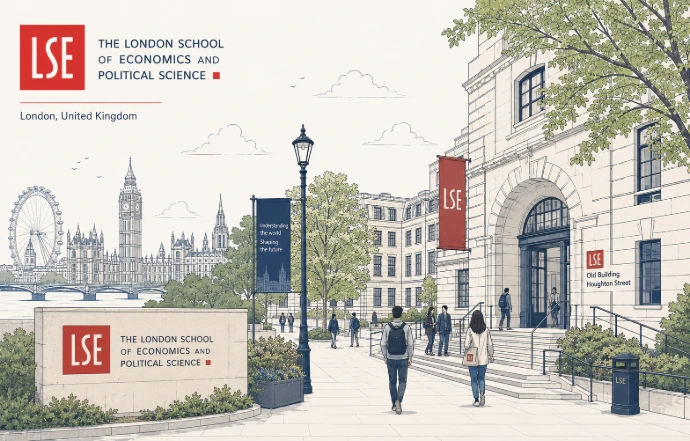
Situated in the heart of central London near Covent Garden and the historic legal district of Holborn, the London School of Economics and Political Science (LSE) is a totally unique, highly specialized global powerhouse. Founded in 1895 by Fabian Society members (including George Bernard Shaw and Beatrice Webb) for the "betterment of society," LSE focuses exclusively on the social sciences. Despite its relatively small physical footprint, its global influence is staggering—LSE has educated dozens of past and present heads of state, billionaires, and nearly a quarter of all Nobel laureates in Economics. Today, the university hosts a deeply driven, hyper-international academic population (with over 70% of its students coming from outside the UK). It draws a fiercely ambitious global cohort seeking direct integration into London's financial epicenter and the highest levels of international policymaking.
\
#62
QS 2027 Rank
#55
TUC 2027 Rank
#12
Europe Rank (TUC)
Stats
● Career and Post-Grad Placement: LSE provides an almost mythical pipeline directly into "The City" (London's financial district), top-tier management consulting, magic circle law firms, and international NGOs. The university's ROI score (89.3%) is exceptionally strong because its graduates frequently command some of the highest starting salaries of any university in the UK.
● Professor Quality: Students are instructed by active policymakers, world-leading economists, and global thought leaders. LSE’s Research Output (89.3%) is formidable, reflecting its status as the UK's leading research institute for the social sciences.
● Study Environment: LSE cultivates a highly intense, pre-professional, and intellectually
rigorous atmosphere. It is famously a "stress-cooker" environment where career
networking begins on day one. Because the campus is seamlessly integrated into central
London, there is no isolated "college town" bubble—students are deeply immersed in the
fast-paced, expensive, and vibrant reality of one of the world's greatest mega-cities.
Courses
40+
Primary UG
100+
Doctoral (PHD)
140+
Masters (PG)
All
Masters (English)
The most popular and brutally competitive undergraduate programs include Economics, Finance, Law (LLB), International Relations, Politics and Philosophy, and Management. Because LSE is a specialist institution, its departments frequently rank in the absolute global top 5 for their respective disciplines, frequently outperforming Ivy League institutions in subjects like Economics and Sociology.
Navigating Admissions: The International Student Pathway
The gateway to LSE is exceptionally strict and uniquely academic. LSE operates through the
UK's centralized UCAS system and is famous for scrutinizing applications with intense detail.
The step-by-step admission process requires:
1. Eligibility & Preparation: Applicants must apply using the centralized UCAS portal, targeting specific degree courses (e.g., BSc Economics) rather than general admission.
2. Academic Excellence: Admissions are relentlessly grades-based. International students must present top-tier scores from globally recognized curricula (e.g., highly competitive A-Level grades typically ranging from AAA to A*AA, or an IB Diploma demanding 38–41 points with top marks in Higher Level subjects).
3. Quantitative Rigor: For elite programs like Economics or Finance, an exceptionally strong background in advanced mathematics (such as A-Level Further Mathematics or IB Higher Level Math) is effectively mandatory.
4. The Personal Statement: This is the make-or-break component for LSE. Because LSE does not conduct interviews for standard undergraduate programs, your 4,000-character UCAS Personal Statement is your only chance to stand out. Admissions tutors are looking for deep, factual evidence of super-curricular academic passion (independent reading, research, or essays directly related to your subject), rather than a list of sports or broad leadership roles.
5. Language Competence: Complete English fluency is strictly required. For standard entry, LSE generally demands a minimum IELTS Academic score of 7.0 (with no sub-band below 7.0) or an equivalent TOEFL iBT score of 100+.
For more Information and personalised answers please join our Discord server https://discord.gg/MtdNBUwF2b (all documents needed and other important things required for your application is posted on the server)
Financial Architecture:
Budget Split (In GBP)
(This is an average data, the actual budget may vary from person to person)
Fees and Annual Budget:
For international students, standard undergraduate tuition generally starts around £26,700 and can scale up to £30,000+ per year depending on the specific program. Master's degrees, particularly in Finance and Economics, carry significant premium fees.
Beyond tuition, an international student must prepare for the exorbitant cost of living in central
London. A realistic estimated annual living budget ranges from roughly £16,000 to £22,000.
This Covers
● Accommodation: ~£9,000 to £14,000/year (LSE guarantees accommodation for first-year undergraduates who apply by the deadline, offering halls in premium central locations like Bloomsbury or South Bank. Private renting for upperclassmen is highly competitive and expensive).
● Food / Board: ~£3,500 to £5,000/year.
● Student Fees, Transport (TfL), & Books: ~£1,500 to £2,500/year.
● UK Healthcare Surcharge: A mandatory fee for the student visa, providing access to the
National Health Service (NHS).
(for more information please visit The London School of Economics and Political Science)
Funding the Future:
Scholarship Opportunities:
While UK universities are notorious for lacking international financial aid, LSE stands out by actually offering targeted, need-based support.
● LSE Undergraduate Support Scheme (USS): Unlike most British universities, LSE runs a specific scheme designed to help international undergraduate students who do not have the necessary funds to meet the full cost of study. The amount awarded varies based on financial need, though full-ride awards are exceptionally rare.
● Targeted Scholarships: LSE occasionally offers region-specific or subject-specific merit scholarships, funded by high-net-worth alumni or corporate sponsors.
● Graduate Funding: At the Master's and Ph.D. levels, funding is significantly more robust, including the prestigious LSE Master's Awards and PhD Studentships, which can cover full fees and provide an annual living stipend.
For more scholarship updates and options please find it on our discord server https://discord.gg/MtdNBUwF2b
Why Choose LSE?
The Ultimate Catalyst for Global Influence: If you are looking past standard brochure data,
the ultimate reason to attend LSE is its total immersion in the mechanics of global power and
finance. By studying at LSE, you are physically situated at the exact intersection where
academic theory meets real-world application. You bypass broad, generalized learning to
become a specialist in how the world operates politically and economically. The campus culture
is heavily ambitious; you will be surrounded by students who are already launching startups,
publishing economic papers, or interning at Goldman Sachs between classes. Graduating from
LSE grants you a universally recognized, elite credential backed by an incredibly powerful
international alumni network that spans from Wall Street to global parliaments.