Overview
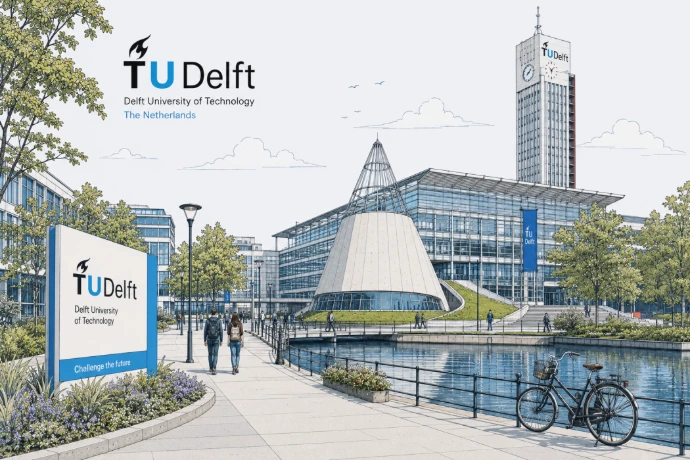
Situated in the historic, canal-lined city of Delft, just a short train ride from the political hub of The Hague and the vibrant port city of Rotterdam, Delft University of Technology (TU Delft) stands as the oldest and largest public technical university in the Netherlands. Founded in 1842 by King William II as a royal academy for civil engineering, TU Delft has evolved into an absolute global titan in engineering, architecture, aerospace, and water management. Operating under a deep-rooted philosophy of practical, impact-driven design, the university boasts a highly innovative, heavily project-based academic culture. Today, TU Delft hosts a brilliantly driven population of over 27,000 students, drawing a fiercely ambitious international cohort eager to tap into its massive global research network and the highly advanced Dutch technology ecosystem.
\
#48
QS 2027 Rank
#54
TUC 2027 Rank
#11
Europe Rank (TUC)
Stats
● Career and Post-Grad Placement: TU Delft provides an incredibly strong pipeline into the European tech and green energy sectors. Graduates are heavily recruited by Dutch corporate titans like ASML (one of the world's most critical semiconductor companies), Philips, and Shell, as well as global engineering and architectural firms. Its impressive ROI score (91.2%) reflects the massive demand for its highly pragmatic, solution-oriented graduates.
● Professor Quality: Students are instructed by leading global figures in quantum computing, coastal engineering, and sustainable aviation. The university’s Research Output (89.1%) is exceptionally robust, fueled by cutting-edge facilities like the legendary QuTech research center and state-of-the-art aerodynamic wind tunnels.
● Study Environment: TU Delft cultivates an intensely rigorous, hands-on, and highly
collaborative atmosphere. The campus is massive, heavily modern, and fully integrated
with research startups. A defining characteristic of TU Delft's culture is its legendary
"Dream Teams"—highly competitive, student-run engineering teams that build everything
from solar-powered cars (consistently winning global challenges) to exoskeletons and
hyperloop pods.
Courses
16
Primary UG
--
Doctoral (PHD)
40+
Masters (PG)
All
Masters (English)
The most popular and fiercely competitive undergraduate programs include Aerospace Engineering, Computer Science and Engineering, Architecture, Civil Engineering, and Applied Mathematics.
Important Note for International Undergraduates: While all Master's programs are taught entirely in English, only a select number of Bachelor's (BSc) programs are offered in English (such as Aerospace Engineering, Computer Science, Nanobiology, and Applied Earth Sciences). The rest are taught in Dutch.
Navigating Admissions: The International Student Pathway
The gateway to TU Delft operates under the highly structured Dutch higher education system, heavily utilizing the national Studielink portal.
The step-by-step admission process requires:
1. Eligibility & Preparation: International students apply via Studielink. To be eligible for a BSc, your international high school diploma must be strictly equivalent to the Dutch VWO (pre-university) diploma (e.g., an IB Diploma, strong A-Levels, or a highly specific combination of standard and AP scores for US applicants).
2. Subject Prerequisites: Meeting the general diploma requirement is not enough. TU Delft demands highly rigorous, specific background knowledge, primarily in advanced Mathematics and Physics, which must be explicitly reflected in your final high school exams.
3. Numerus Fixus (Capacity Caps): This is the most critical factor for popular programs. Highly sought-after English-taught BSc tracks like Aerospace Engineering and Computer Science operate under a Numerus Fixus (a strict cap on student numbers).
4. Selection Procedure: For Numerus Fixus programs, simply meeting the grades is not an automatic ticket in. You must complete a highly competitive decentralized selection process, which often involves taking specific cognitive and academic entrance exams administered by the faculty in February/March.
5. Language Competence: Complete English fluency is strictly required for English-taught tracks. A minimum IELTS Academic score of 6.5 or 7.0 (depending on the program) or a TOEFL iBT equivalent is mandatory.
For more Information and personalised answers please join our Discord server https://discord.gg/MtdNBUwF2b (all documents needed and other important things required for your application is posted on the server)
Financial Architecture:
Budget Split (In EUR)
(This is an average data, the actual budget may vary from person to person)
Fees and Annual Budget:
Because TU Delft is a public Dutch university, the tuition structure varies massively based on your nationality. For EU/EEA citizens, the financial ROI is absolutely staggering. The Dutch government legally caps statutory tuition, meaning EU students pay roughly €2,530 per year. For non-EU international students, the institutional fees are significantly higher, generally ranging from €16,000 to €18,000 for a Bachelor's degree, and jumping to €20,000+ per year for a Master's degree.
Beyond tuition, the most significant hurdle for international students in the Netherlands is the
national housing crisis. An international student should prepare for an estimated annual living
budget of roughly €14,000 to €18,000
This Covers
● Accommodation: ~€6,000 to €9,000/year (TU Delft does not have a traditional sprawling American-style dorm system. While they offer a highly limited housing service for first-year internationals, finding private student housing in Delft or nearby cities like The Hague is fiercely competitive and expensive).
● Food / Board: ~€3,500 to €5,000/year.
● Student Fees, Bike (Essential), & Books: ~€1,000/year (You will bike everywhere; a second-hand bicycle is a mandatory purchase).
● Health Insurance: Mandatory under Dutch law.
(for more information please visit https://www.tudelft.nl/en/)
Funding the Future:
Scholarship Opportunities:
The financial aid landscape for international students in the Netherlands is highly restricted and almost entirely merit-based at the graduate level.
● Undergraduate Funding: Like almost all Dutch public universities, TU Delft offers virtually zero institutional scholarships or need-based aid for incoming international Bachelor's (BSc) students. Non-EU students must prove they have the financial means to cover the full cost of tuition and living expenses to secure a student visa.
● Justus & Louise van Effen Excellence Scholarships: This is the crown jewel of funding at TU Delft, but it is reserved exclusively for outstanding international applicants applying to Master's (MSc) programs. It is heavily competitive, offering a full tuition waiver and a living stipend.
● Holland Scholarship: Co-financed by the Dutch Ministry of Education and TU Delft, this offers a minor, one-time grant (typically €5,000) for excellent non-EEA students in their first year of study
For more scholarship updates and options please find it on our discord server https://discord.gg/MtdNBUwF2b
Why Choose Delft University of Technology?
The Ultimate Engine of European Engineering: If you are looking past standard brochure
data, the ultimate reason to attend TU Delft is its uncompromising dedication to real-world,
highly tangible innovation. You are not just sitting in theoretical lectures; you are explicitly
trained to solve the massive, complex challenges facing modern society—from climate
adaptation and flood defense to quantum architecture and sustainable aviation. By stepping
onto this campus, you integrate into one of the most respected tech ecosystems in Europe.
Graduating from TU Delft grants you an elite, globally recognized technical degree backed by a
culture that values relentless pragmatism, teamwork, and brilliant design above all else.