Overview
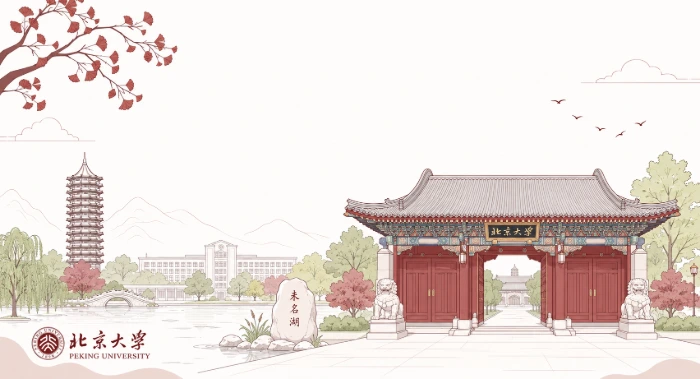
Situated in the Haidian District of northwest Beijing, Peking University (PKU) stands as the undisputed intellectual beating heart of China. Established in 1898 and originally known as the Imperial University of Peking, its 274-hectare campus—affectionately known as "Yan Yuan" (the Garden of Yan)—is built on the former site of Qing Dynasty royal gardens. It seamlessly blends classical Chinese landscaping, featuring the iconic Weiming Lake and Boya Pagoda, with hyper-modern research facilities. Operating under the enduring spirit of "Freedom of thought, inclusivity" (思想自由,兼容并包), Peking University acts as the primary catalyst for China's cultural, political, and scientific evolution. Today, the university boasts a massive academic population of over 48,000 students, including a highly diverse international cohort of roughly 4,300 to 5,000 students representing over 130 nations.
#13
QS 2027 Rank
#9
TUC 2027 Rank
#1
Asia Rank (TUC)
Stats
● Career and Post-Grad Placement: PKU reports an extraordinary overall placement rate, typically hovering around 96% to 98%. Undergraduates entering the workforce directly are heavily recruited by top-tier consulting firms, government sectors, and tech giants like Tencent and Alibaba. For those pursuing academia abroad, a massive percentage secure admission to the world's top 20 universities (such as Harvard, Oxford, and Stanford), though the majority of verified alumni eventually root their careers in China's rapidly expanding economic and technological ecosystem.
● Professor Quality: With a massive faculty including over 110+ distinguished academicians from the Chinese Academy of Sciences (CAS) and the Chinese Academy of Engineering (CAE), students are instructed by the active creators of modern academic paradigms. The university consistently wins prestigious national awards for teaching quality and breakthrough research.
● Study Environment: Often dubbed the "Harvard of China," PKU cultivates an atmosphere of intense intellectual curiosity and critical thought. Student reviews praise the campus's profound historical resonance, world-class libraries (housing over 7.3 million volumes), and a collaborative yet highly competitive culture. With over 100 active student clubs and extensive cultural workshops, international students are easily integrated into the broader university community.
Courses
130
Primary UG
301
Doctoral (PHD)
200+
Masters (PG)
30+
Masters (English)
The most popular and highest-ranked programs include Modern Languages, Linguistics, Chemistry, Computer Science, Law, Economics, and Medicine. Recently, Peking University has expanded its interdisciplinary pedagogical models. Institutions like Yuanpei College are designed to break down traditional disciplinary boundaries, ensuring elite undergraduates receive a deep foundation in the liberal arts, AI, and natural sciences before specializing, allowing them to freely choose their major after their first year.
Navigating Admissions: The International Student Pathway
While domestic Chinese students face a brutally competitive Gaokao acceptance rate of less than 0.1% for PKU, the gateway for international students is structurally different. Peking University utilizes a holistic evaluation process for international applicants, resulting in a more accessible acceptance rate estimated between 10% and 25%.
The step-by-step admission process requires:
1. Eligibility: Applicants must be non-Chinese citizens holding a valid passport. (Those who have immigrated must provide absolute documentation proving the cancellation of their Chinese nationality).
2. Academic Excellence: Undergraduates typically need credentials equivalent to a high SAT (1450+) or ACT (32+), alongside a stellar GPA (3.8+). For students who do not meet standardized testing waivers, the Peking University International Student Entrance Exam may be required.
3. Language Competence: English-taught programs mandate a minimum TOEFL score of 90 to 100 or an IELTS score of 6.5 to 7.0. Programs taught in Mandarin strictly require HSK Level 5 or higher.
4. CSCA Examination / Standardized Assessments: For undergraduate applicants aiming to enroll via specific government tracks (like the Chinese Government Scholarship), passing the China Scholastic Competency Assessment (CSCA) or the university's proprietary foundational academic exams in subjects like Mathematics, Physics, and Professional Chinese is often a mandatory requirement.
5. Documentation & Interviews: Applications require a personal statement, authenticated degree certificates, academic transcripts, recommendation letters, and a physical examination form. Shortlisted candidates will then be invited for a rigorous integrative test or virtual interview.
For more Information and personalised answers please join our Discord server https://discord.gg/MtdNBUwF2b (all documents needed and other important things required for your application is posted on the server)
Financial Architecture:
Budget Split (In RMB)
(This is an average data, the actual budget may vary from person to person)
Fees and Annual Budget:
Despite its elite standing, PKU represents a massive financial ROI compared to Western institutions. Annual tuition typically ranges from 26,000 RMB (Humanities) to 30,000 RMB (Sciences) (approx. $3,600 to $4,150 USD) for standard undergraduate programs. Specialized postgraduate degrees carry higher costs, such as standard Master's programs running 29,000 to 33,000 RMB, up to 190,000+ RMB for elite corporate MBA pathways.
Beyond tuition, an international student living on or near campus should prepare an estimated annual budget of roughly 55,000 RMB (approx. $7,600 USD).
This covers:
● Accommodation: ~35,000 RMB/year depending on whether you secure a spot in Zhongguanxinyuan (the Global Village) or rent off-campus.
(please visit https://english.pku.edu.cn for more data)
● Comprehensive Medical Insurance: 800 RMB/year.
● Living Expenses (Food, Transport): ~15,000 to 30,000+ RMB/year
Funding the Future:
Scholarship Opportunities: Peking University offers a deep reservoir of financial aid, but there is one strict rule: you must secure a pre-admission offer before applying for university-administered scholarships.
● Chinese Government Scholarship (CGS): The most prestigious award. A Full CGS covers the entirety of tuition fees, provides free university housing, and issues a monthly living stipend alongside medical insurance.
● Tuition/University Scholarships: Merit-based awards, such as the Beijing Government Scholarship (BGS) or the Peking University Scholarship (PKUS), which cover full or partial tuition for one academic year and are re-evaluated annually based on academic performance.
● Program-Specific Funding: Elite fellowships like the Yenching Academy program offer fully funded master's degrees in China Studies for international students, covering tuition, accommodation, travel, and a generous living stipend.
For more scholarship updates and options please find it on our discord server https://discord.gg/MtdNBUwF2b
Why Choose Peking University?
The Epicenter of Free Thought and Future Tech: If you are looking past standard brochure
data, the ultimate reason to attend Peking University is its unparalleled influence over China's
intellectual and political trajectory. While traditionally the undisputed king of humanities, law, and
social sciences, PKU is moving aggressively into the future. Through the creation of institutions
like the Institute for Artificial Intelligence and the College of Future Technology, PKU is
anchoring the convergence of deep tech and humanistic inquiry. By stepping onto this campus,
you bypass the academic periphery and place yourself at the very heart of the critical
conversations shaping global policy, modern medicine, and the next generation of artificial
intelligence